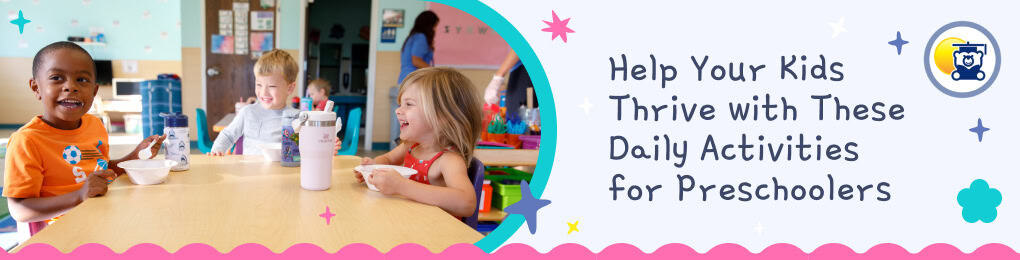
Children learn best when they feel safe and in control. At Kiddi Kollege, we give children a sense of security through a regular routine that parents can even follow at home. Over the past 65+ years taking care of children, we’ve found that the following daily activities for preschoolers help them learn and grow the best:
- Breakfast/morning snack
- Circle Time
- Center Time
- Outdoor Play
- Center Time
- Lunch
- Nap
- Snack
- Outdoor Play
- Center Time
- Pickup
Every class in our centers (except for the infants class) follows this daily routine and reaps the rewards each activity offers. Follow this schedule in your own home, even on weekends, and watch your child embrace the routine and continue to learn.
Breakfast, Lunch, and Snacks
Little minds can’t learn if their bellies are rumbling. Children need breakfast, lunch, and several snacks throughout the day. But you shouldn’t provide just any kind of food for your child. Serve them the best brain food around to nourish their minds. You can do this by providing whole foods, low sugar treats, and seasonal fruits and vegetables. This brain food helps your child’s mind work better so they can learn and retain more throughout the day.
Meals and snacks aren’t just a time to fuel up; they’re also a great way to build communication skills. By holding “family-style” meals, your child can eat with you or their friends while also talking about each other’s days. This not only ensures your child is getting the nutrients they need to grow but is also learning how to interact with others and make friends.
Circle Time
After breakfast, follow early childhood educators’ leads and hold circle time to officially start your day. During circle time, you should:
- Share the theme for the day
- Explain the day’s activities for preschoolers
- Assign tasks to your child for the day, like helping you with the dishes
This activity is vital to starting the day off on the right foot. Circle time gives children space to transition to the rest of the day and provides them with a clear schedule, so they know what to expect. Changing activities can stress children out, so letting them know when to expect transitions in advance can help the day go more smoothly.
Allowing children to help with small chores or jobs might not seem like a big deal to adults, but it is to your little ones. These chores can make children feel helpful and important. This in turn helps nurture their self-confidence and independence, both vital skills every child should develop.
Center Time
Center time focuses on preschool educational activities to help children learn and grow. It can feel daunting trying to educate your young child. At Kiddi Kollege, we strive to make lessons fun and engaging. Instead of using worksheets, we provide hands-on activities for preschoolers. You can too by using the following:
A Strong Curriculum
When children have a well-rounded education, they are already on their way to becoming well-rounded adults. That’s why we provide and suggest activities for preschoolers in the following subjects:
- Art
- Math
- Science
- Language arts
- Music
- Practical life skills
- Social studies
- Dramatic play
- Manipulative play
Over the past 65+ years, Kiddi Kollege has continued to refine its curriculum to ensure children get the best early education possible. This has resulted in Bear Boulevard, our curriculum “Where all roads lead to success.” For tips on how to create fun and educational activities for preschoolers at home, sign up for our monthly newsletter.
Differentiated Instruction
Every child is unique and will learn better in different ways. That’s why we use and recommend differentiated instruction. Differentiated instruction tailors preschool educational activities to every child’s learning style, so no one is left behind in lessons. For example, after reading a story, one child may draw a picture about it, another may act it out for the class, and another may write a sentence about it. Take the time to work with your child and try new activities for preschoolers to see how they learn the best. This not only helps children develop in growth areas but also refine their strengths. As a result, children grow their knowledge, self-esteem, and independence.
Outdoor Play
We’ve all heard the saying, “All work and no play makes Jack a dull boy.” Sometimes kids just need to be kids, and that’s where outdoor play comes in. in fact, according to the World Health Organization, children ages three to four should spend at least 3 hours a day playing. That’s why every one of our early learning centers comes with a fun and safe playground where kids can run around and play. We also offer physical activities for preschoolers as electives like:
- FitKids: An athletic program that rotates sports every year and offers weekly on-site lessons.
- Tippi Toes Dance: On-site classes with ballet, tap, jazz, and hip-hop lessons with performances across the year.
- Happy Feet: Introductory soccer lessons from coaches that come to our centers to hold lessons.
Outdoor play and physical activities for preschoolers nurture kids’ minds and bodies so they can stay happy and healthy. Without it, you have antsy children who can’t focus or are too bored to learn anything.
Looking for Activities for Preschoolers to Do at Home?
Engaging your child’s mind while ensuring they’re having fun can sometimes feel impossible. But you don’t have to find new ways to entertain them on your own. Sign up for our monthly newsletter for more tips and activities for preschoolers that you can do at home with your little one.
Daily Activities for Preschoolers FAQs
Daily activities for preschoolers provide structure, security, and consistency. When children know what to expect, they feel more confident, focused, and ready to learn.
Early childhood educators guide children through routines, model positive behavior, and adapt learning experiences to meet each child’s needs while building trust and confidence.
Circle time helps children transition into the day, understand expectations, and build communication skills. It also helps them feel included and prepared for upcoming activities.
Differentiated instruction allows teachers to tailor lessons to different learning styles. This ensures every child can engage with preschool educational activities in a way that works best for them.
Activities for preschoolers like center time, group meals, and outdoor play encourage sharing, cooperation, and communication with peers.
Center time includes art, math, science, language arts, music, dramatic play, and manipulative play. These preschool educational activities support academic and motor development.
Nutritious brain food fuels growing bodies and minds. Balanced meals and snacks help children stay focused, energized, and ready to participate in learning activities.
Outdoor play supports physical health, emotional regulation, and focus. Physical activities for preschoolers help children release energy so they can learn more effectively indoors.
Through differentiated instruction, early childhood educators observe each child and adjust activities to challenge strengths while supporting growth areas.
Preschool educational activities build academic readiness, independence, social skills, and confidence, helping children transition smoothly into kindergarten and beyond.
Enjoy content from Kiddi Kollege? Make us one of your preferred sources on Google.