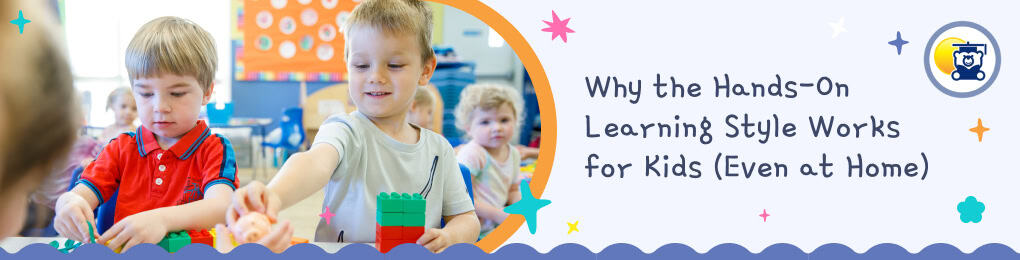
Be honest: do you ever remember enjoying worksheets when you were in school? On a similar note, do you even remember what those pieces of paper were trying to teach you? These boring, ineffective worksheets have somehow become a staple in education, even as early as preschool. But the truth is they just don’t work. We’ve seen this firsthand at our early learning centers, which is why we use a more effective learning style parents and their young children love: hands-on learning.
Not convinced this learning style is for your child? Keep reading to learn everything you need to know about hands-on learning, including:
- Why hands-on learning works
- How hands-on activities support every learning style
- Hands-on learning activities to do at home
Let’s get started and explain what makes hands-on learning so valuable for young minds.
Why Hands-On Learning Works
So, how exactly does a hands-on learning style work? Instead of lectures or books where information is just given to children, hands-on activities make learning a direct experience. It makes abstract concepts real by having children do educational activities that engage multiple senses. This not only makes learning more fun, engaging, and memorable, but it also helps children understand concepts better. It’s also why many early learning programs use hands-on activities as part of differentiated instruction to support every child.
It Makes Lessons Stick
When children engage multiple senses, they are more likely to remember what happened. The same is true for when they are having fun. Listening to lectures or reading a textbook can’t do this. Hands-on activities require children to actively participate, which helps them remember the experience and the lesson it was teaching. For example, you might not remember what your science textbook said about chemical reactions, but you do remember that baking soda volcano experiment. The hands-on learning style makes memories that will stick with your child for years to come.
It Builds Real Thinking Stills
Education is about more than just retaining information for later. It’s about developing critical thinking skills your child will use for the rest of their lives. The hands-on learning style often involves real-world challenges that children will have to figure out. Children have to analyze the situation and come up with creative solutions, which are skills that will become invaluable as they grow up. That isn’t something a textbook can teach them.
It Sparks Curiosity
Young children are constantly learning about the world around them, and it’s never too early to start challenging their minds. Children learn better when they actually want to learn. Traditional lectures and books rarely engage young children the same way the hands-on learning style does. Hands-on activities get children excited to learn and even encourage them to ask questions. Nurturing this curiosity is crucial as it leads to a stronger learning experience and makes lessons more memorable.
How Hands-On Activities Support Every Learning Style
Every child is different, and that means that every child learns best with a different learning style or combination of learning styles. The good news is that hands-on activities work for all learning styles at the same time. So instead of trying to fit your child into one way of learning, hands-on activities naturally meet them where they are. How do these activities do this? It’s simple:
- For visual learners: Hands-on learning lets them observe changes step by step and shows them real results in real time.
- For auditory learners: Adults can talk through what they are doing in the hands-on activity and encourage children to explain what happened.
- For kinesthetic learners: They can use their hands to understand new ideas being presented in hands-on activities and stay engaged instead of sitting still.
The hands-on learning style combines seeing, hearing, and doing all at once. This approach naturally supports differentiated instruction and can feel like an individualized education program because it meets each child where they are. Teachers just have to make a hands-on activity that covers the day’s lesson.
Hands-On Learning Activities to Do at Home
Hands-on learning activities don’t have to be complicated or time-consuming to be impactful. And there are plenty of interactive preschool science experiments you can do at home with your little one to keep them learning. Check out our top preschool science experiments below:
Sink or Float
This preschool science experiment is a classic and you likely already have all the materials you need! Fill up your sink or a tub with water, then choose some items that will sink and some that will float. These could be a crayon, rubber duck, or anything you don’t mind getting wet. Once you’ve gathered these materials, ask your child to tell you which objects they think will sink and which ones will float. Then you can test it out and explain why each item did what it did.
Color Mixing
If you have a little artist, this is the perfect preschool science experiment for them. Use food coloring to create cups of different colored water. Then provide your child with cards of colors for them to make, droppers, and small cups or dishes they can mix the colored water in. This will teach them how different colors can make new colors when combined in an engaging way.
Ice Cream in a Bag
Even on hot summer days, you can still provide your child with fun preschool science experiments to engage their hands and brains. Making ice cream in a bag may just seem like a fun activity with a delicious outcome, but it can actually be a great way to introduce your child to different states of matter. For this experiment you’ll need:
- Milk
- Sugar
- Vanilla
- Ice
- Salt
- A small plastic bag
- A large plastic bag
- Spoon
- Any topping you want
Half of these ingredients are liquids and half are solids. But when you combine them properly, they become a liquid cream mixture somewhere between the two states of matter. This will blow your child’s mind. To make ice cream in a bag, combine a cup of milk, half a teaspoon of vanilla extract, and one tablespoon of sugar into the small bag. Seal the bag and then fill the larger bag with ice and ¼ cup of salt. Place the small bag in the big bag, seal the larger bag, and shake for about six minutes. Watch as the ingredients turn into ice cream before your child’s eyes, stopping intermittently to observe the changing states of matter up close. Then, enjoy a sweet treat with your favorite toppings.
Marshmallow and Toothpick Tower
All you need for this preschool science experiment is a bag of marshmallows, toothpicks, and a flat surface. Then challenge your child to build a tower using the marshmallows to connect toothpicks. This not only develops their fine motor skills but also teaches kids about shapes and basic building skills.
Ready to Help Your Child Love Learning?
Hands-on learning is one of the simplest ways to help your child grow. But you don’t have to figure it out on your own. At Kiddi Kollege, we use hands-on activities every day to support each child’s learning style, build confidence, and create a love for learning that lasts. Our approach is built on differentiated instruction, helping every child learn in a way that works best for them. Sign up for our monthly newsletter for more simple ideas like the ones in this guide, along with expert tips and easy activities you can do at home.
Frequently Asked Questions About the Hands-On Learning Style
A learning style is the way your child understands information best. Some children learn by seeing, some by hearing, and others by doing. When you match how your child learns, it helps them understand faster and feel more confident.
Hands-on learning combines seeing, hearing, and doing all at once. This means it works for visual, auditory, and kinesthetic learners at the same time, making it one of the most effective ways to teach young children.
Differentiated instruction is a teaching method where lessons are adjusted to fit each child’s needs. Hands-on learning naturally supports differentiated instruction because children can explore and learn in their own way.
An individualized education program is a plan created to support a child’s specific learning needs. While IEPs are used in schools, hands-on learning at home can also support those same goals by helping children learn in ways that work best for them.
Yes. Hands-on learning is especially helpful for children with an individualized education program because it allows them to learn at their own pace and in a way that matches their strengths.
Simple activities like sink or float, color mixing, ice cream in a bag, and building towers with marshmallows are great preschool science experiments that teach important skills in a fun way.
You can include hands-on learning every day through simple activities like cooking, playing, or exploring outside. Even a few minutes of focused activity can make a big impact.
Yes. Hands-on learning helps children understand concepts more deeply and remember them longer, which can lead to better performance in school over time.
That is okay. Hands-on learning does not need to feel structured. Follow your child’s interests and turn everyday moments into learning opportunities.
No. Most hands-on activities can be done with items you already have at home. Simple tools like water, food coloring, or household objects can create meaningful learning experiences.
Enjoy content from Kiddi Kollege? Make us one of your preferred sources on Google.