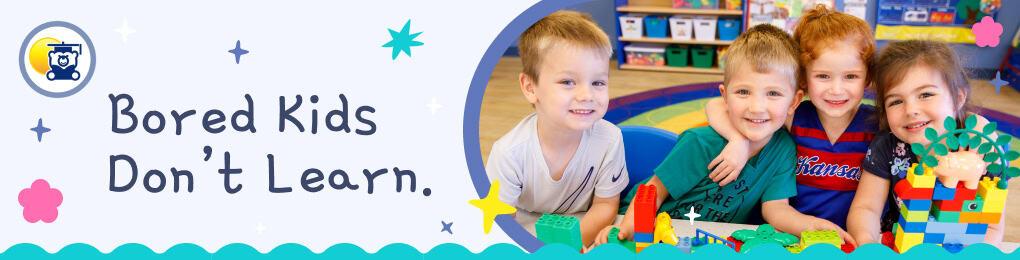
Be honest, do you remember anything from that boring history class with the teacher who just droned on and on? Probably not. So why would you expect your child to learn anything from a similarly dull environment?
Our early learning center was born from a mother’s dream for a better, more engaging learning environment for her young children, a core belief that has shaped our classrooms. To ensure every child has fun while also getting a good education, all our childcare centers have the following:
- Playful and welcoming rooms
- Play-based learning
- Differentiated instruction
- Experienced and engaging teachers
These factors aren’t just important to make sure your child is having fun, but to ensure they’re developing all the skills they need for kindergarten and beyond. And since not every early education center uses these techniques, you need to know exactly what to look for when touring childcare facilities.
Daycare vs. Early Education Centers vs. Schools
Before anything else, you must understand the different childcare options available to you. For children ages six weeks to five years of age, there are two main options: daycare and early education centers. While these terms are often used interchangeably, they are actually quite different from one another. Daycares and early education centers tend to differ in the following ways:
- Daycares only provide a safe place for children to stay. Early education centers provide a safe place along with structured learning.
- Daycares focus on supporting basic developmental skills. Early education centers help children develop cognitive, social, emotional, and educational skills.
- Daycare staff are only required to complete necessary safety training and licensing. Early education centers’ staff must meet these same requirements as well as having significant educational experience.
Ultimately, daycare and early education centers are meant to get children ready for school and life beyond. Schools tend to be far more structured than these childcare options though and require more from their students. By choosing the right childcare option, you prepare your child for school and whatever else life requires of them.
Playful and Welcoming Rooms
If your child doesn’t feel safe, then they definitely aren’t going to learn anything. Dropping your child off at an early learning center for the first time can be frightening for your little one. You’re leaving them in a brand-new space with strangers after all. That’s why it’s vital that your early education center have cheerful, cozy rooms your child will instantly feel at home in. What do these rooms look like? Generally speaking, each room should have:
- Enough space for children to play
- Safe spaces with pillows, family photos, and calming tools
- Bright colors and fun decorations
- Comfortable, child-sized furniture
When combined, these components create a welcoming and engaging space for children. This, along with supportive teachers, makes children feel at ease and ready to learn.
Play-based Learning
Boring lectures are a surefire way to lose anyone’s attention, especially little ones with seemingly boundless energy. Children are still learning how to focus, communicate, and regulate their emotions, so expecting them to sit still and do worksheets all day is a recipe for disaster. One the other hand, a fun activity preschool kids will learn from is a great alternative. This is also known as play-based learning, a strategy that gets kids involved, motivated, and eager to learn.
Teachers using play-based learning just need to have a clear learning goal behind it so they can subtly guide children. After all, if the child is just told the answer, they will have a harder time retaining the lesson. But if they have to get their hands dirty so to speak, their new skill will be ingrained in their brain along with a fun memory.
Differentiated Instruction
Every child learns in their own way and at their own pace. Differentiated instruction is a strong strategy where teachers adjust how they teach based on each child’s needs. For example, some children learn best by moving while others learn best by talking or drawing. In a high-quality early education center, teachers pay attention to these differences and respond to them to help children learn and grow.
Differentiated instruction does not mean that children are separated or labeled. It means that teachers offer many ways to learn the same skill. One child may count blocks on the floor while another sings a counting song. The goal is the same, but the path to get there looks different for each child.
Experienced and Engaging Teachers
No early education center is complete without outstanding teachers. They are truly what makes or breaks a child’s experience with childcare. High-quality teachers should be able to build trust with your child and create a space for them to have fun and learn at the same time. Here’s some characteristics to look for in teachers that go above and beyond:
- Obvious passion for childcare
- Experience in early childhood education
- Ongoing continuing education
- Trained in Conscious Discipline
When early education center teachers truly care for their children and have the knowledge to help them learn, you know your little one is in good hands.
Early Education Center FAQs
A daycare focuses mainly on keeping children safe while parents are at work. An early education center goes further by combining care with structured learning that supports social, emotional, and brain development.
Children learn best when they are engaged. A fun early education center helps children stay curious, motivated, and open to learning new skills every day.
An activity preschool is a program that uses hands-on play, movement, and creative activities to teach early skills. Learning happens through games, exploration, and guided play rather than worksheets.
Play-based learning allows children to practice skills naturally. In an activity preschool, children learn problem-solving, language, and social skills while having fun.
Differentiated instruction means teachers adjust lessons to fit each child. Some children learn by moving, others by talking or building. Teachers use different methods so every child can succeed.
Teachers guide play with purpose. In an activity preschool, one child may learn counting with blocks while another sings a number song, both learning the same skill.
Look for classrooms with activity areas, movement, art, and pretend play. A strong early education center explains learning goals behind play, not just free time.
An activity preschool should feel warm and inviting. Look for open space, child-sized furniture, play centers, and calming areas where children feel safe.
Teachers plan activities with clear goals. Through differentiated instruction, they guide learning while letting children explore and stay engaged.
Yes. Children who learn through play build strong social skills, confidence, and problem-solving abilities that help them succeed in school later.
Looking for Ways to Make Learning Fun at Home?
High-quality early education centers like Kiddi Kollege strive to make learning fun and engaging for your child. But the learning doesn’t have to stop at the early education center. There are so many ways you can help nurture your child’s education without becoming a teacher yourself. Sign up for our monthly newsletter to get tips on how you can continue fun learning at home.
Sign Up for Our Newsletter
Enjoy content from Kiddi Kollege? Make us one of your preferred sources on Google.