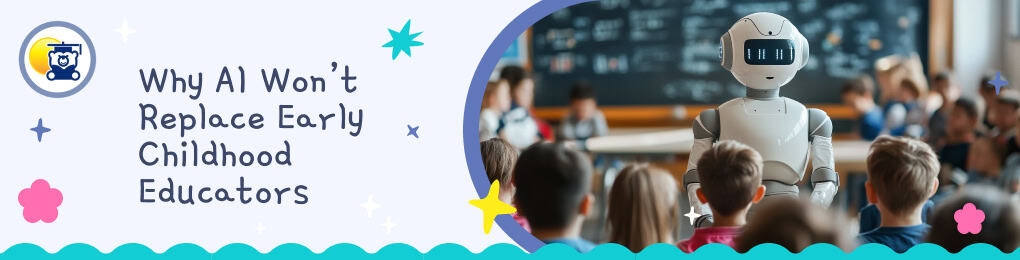
Artificial Intelligence is working its way into almost every profession, so it’s only a matter of time before it starts taking human teaching jobs, right? Wrong. Parents, you don’t have to worry about your child being raised by AI. As a team of early childhood educators, we have seen firsthand how young children and their parents benefit from a personal, human approach to teaching rather than an AI method. Here’s why AI won’t be replacing early childhood educators anytime soon:
- Human supervision is legally required
- Educators help children grow academically and personally
- Children learn better with human connection
- AI is a tool, not a replacement
AI teachers are not going to take over, despite the changes this technology is bringing to our daily lives. Keep reading to get an in-depth explanation of why human educators will be around to care for your children for a long time.
Legal Requirements
AI tutors may be able to explain concepts in a simple way, but they cannot supervise children and keep them safe. Legally, human early childhood educators are required to care for children. In Kansas specifically, licensed childcare centers must follow the Kansas Administrative Regulations which require staff to:
- Maintain visual and auditory awareness of children
- Stay close enough to intervene quickly
- Monitor children during activities, meals, and rest
- Regularly check children who are sleeping
Additionally, all early childhood educators supervising children need to be licensed by the state and have completed safety training to ensure proper action can be taken if an emergency arises. At this point in time, AI tutors cannot properly supervise children, let alone act if a child is in danger. Not only would using an AI teacher result in legal repercussions for the education center but would also put children at severe risk. Young children especially need human teachers to protect them and help them grow.
The Importance of Personal Growth
Early childhood educators don’t just teach academics; they also help young children learn necessary behavioral, emotional, and developmental skills. This is something AI teachers simply can’t do. AI may be able to mimic human emotion, but it doesn’t actually feel anything and will adapt to be more well-liked by the user. As a result, it’s more likely to let children do whatever they want than teach them morals and strong relationship skills. Interactions with human teachers also help children learn about tone, eye contact, conversation flow, and more. Children might be able to develop these skills with parents and other adults, but this will take longer without daily exposure to early childhood educators.
While communication is important, it isn’t the only important skill children learn from early childhood educators. Children are constantly observing those around them and picking up on behaviors from adults. It’s from them that children learn how to handle their emotions in a more mature manner. After all, an AI teacher might be able to provide a list of steps a child should take to calm down, but this won’t be effective during a tantrum. Early childhood educators can hold children who are in distress and actually talk to them about what they are feeling. These interactions teach children proper emotional responses, coping mechanisms, and resilience they wouldn’t get from an AI teacher.
Human Connection Improves Student Learning
Children learn best when they feel safe, seen, and understood. This is why early childhood educators are so important. A caring teacher does more than share facts; they watch how each child learns, what interests them, and what challenges they face. This allows early childhood educators to adjust lessons to meet each child’s needs through an individualized education program.
An individualized education program helps teachers create a plan that fits the way a child learns best. Some children learn through movement, while others need to talk through their ideas. Early childhood educators recognize these differences and can change their teaching style to support each child. An AI tutor may be able to provide information quickly, but it cannot truly understand the needs of a child the way a human teacher can. For example, an early childhood educator may notice when a child seems frustrated with a task and be able to encourage them. AI teachers cannot.
Additionally, humans learn best through interaction with other humans. Even adults who use AI to “learn” aren’t really retaining the information they’re gathering. Not to mention simply putting a question into a chatbot delivers an answer immediately, hindering our problem-solving skills. But even the AI responses themselves aren’t always right and fail to address a user’s current knowledge. For example, you can’t start teaching a child about multiplication if they don’t fully understand addition yet. AI tools don’t know how much their users know and therefore can’t provide a structured curriculum to fully explain topics.
The attention human teachers provide students is very important because it helps build trust. And when children trust their teachers, they feel more comfortable asking questions and trying new things. This helps them learn faster and develop confidence in their abilities. AI teachers simply can’t meet children’s emotional needs that are just as important as their academic ones.
How AI Can Help Early Childhood Educators
While AI cannot replace early childhood educators, it can still be a helpful tool as long as it is guided by human teachers. When used properly, AI can greatly improve productivity across various fields. It does so by automating “busy work” so teachers can focus on creating the best lessons for all their students. But how exactly do teachers get AI to do this? By optimizing the following benefits.
Simplifies Lesson Planning
An early childhood educator has to continually come up with new lesson plans to meet administrative requirements and help their students learn. AI tools can help take a teacher’s ideas and make them classroom ready faster. For example, you may create a lesson plan that works great for visual learners, but not so much for children with other learning styles. An AI tool can help differentiate lesson plans to accommodate all the children in a classroom, ensuring they have the best chance of learning the new lesson. This does not mean a teacher should use AI tools to create their entire curriculum though as this could lead to inaccurate information, surface-level lessons, and further learning difficulties. And the human teacher will still need to lead the lesson and watch how children respond to the activity so they can adjust it if necessary. This ensures the learning experience is both personal and supportive.
Analyzes Learning Progress
Instead of making time to analyze each child’s progress via a massive spreadsheet or tracking tool, teachers can use AI to help do this for them. AI tools can identify learning gaps, patterns across grade levels, and how each student is progressing in their studies. This saves human teachers hours of time they can now devote to adjusting lesson plans and helping children who are struggling.
Performance Administrative Tasks
AI in education isn’t just about helping children learn, it’s also about making human teachers’ lives easier. The right AI tool can help teachers filter through and respond to emails, keep track of accommodation checklists, and perform routine documentation tasks. Once again, this frees up early childhood educators’ time to help students, talk to parents, and create strong individualized education programs.
Stay Up to Date on the Latest Early Education Trends
AI isn’t taking over early learning centers, but it is giving teachers more time to help your child. Every child deserves a strong education that sets them up for the rest of their lives. That’s why we stay up to date on all the latest and best teaching practices. Sign up for our newsletter to learn more about how we help the children in our early education centers and get helpful tips you can use to educate your child at home.
AI in Education Frequently Asked Questions
No. Early childhood educators provide supervision, emotional support, and human interaction that AI cannot replicate. Young children require personal guidance, safety monitoring, and social development that only human teachers can provide.
No. An AI teacher cannot physically supervise children or respond to emergencies. Early childhood education programs require trained staff to maintain supervision and ensure the safety of children throughout the day.
AI in education can be used as a tool to support learning activities, generate lesson ideas, and provide practice exercises. However, it works best when guided by early childhood educators who ensure children are learning in safe and developmentally appropriate ways.
An individualized education program is a plan designed to support the unique learning needs of a child. Early childhood educators create these programs to adjust lessons and activities so each student can succeed.
An AI tutor can help children review information or practice skills, but it cannot replace a classroom teacher. Early childhood educators guide learning, support emotional growth, and help children develop important social skills.
Human interaction helps children develop communication skills, emotional understanding, and social awareness. Early childhood educators model behaviors like listening, empathy, and cooperation that children learn through observation.
Teachers help children identify feelings, practice calming strategies, and learn how to interact with others. These experiences help children develop emotional regulation and resilience.
AI tools may help analyze learning progress or suggest activity ideas, but early childhood educators still design and guide individualized education programs based on their understanding of each child.
Children learn better when they feel supported and understood. Early childhood educators provide encouragement, guidance, and feedback that helps children stay motivated and engaged.
AI will likely continue to support teachers with planning tools, practice activities, and data insights. However, early childhood educators will remain essential because learning requires human connection, supervision, and emotional support.
Enjoy content from Kiddi Kollege? Make us one of your preferred sources on Google.